Author: Paul Morrissey

  • When Vibe Coding Meets the Real World: Security, Governance and the Rise of S2aaS

    When Vibe Coding Meets the Real World: Security, Governance and the Rise of S2aaS

    The question is no longer whether AI can generate code. It clearly can. The real question is whether “vibe coded” products can be trusted, governed and secured well enough to be taken seriously inside an enterprise.

    Over the past year, tools such as Claude, OpenAI, Gemini and others have dramatically lowered the barrier to software creation. What many are now calling vibe coding allows founders, product teams and even non-engineers to produce working applications at remarkable speed. Prototypes that once took months can now appear in hours. That is genuinely transformative.

    But it also creates a dangerous illusion. The ability to generate software quickly is not the same as the ability to create software that is secure, resilient, compliant and enterprise ready. In fact, the faster code is created, the more important governance becomes. The risk is not that AI-generated code fails to compile. The risk is that it appears to work while hiding weaknesses that only emerge later under attack, under regulation, or under enterprise scrutiny.

    Where the problem begins

    This is where vibe coding may hit the rocks. Not because the model cannot write code, but because code alone is only one small part of software assurance. Enterprise-grade products require secure architecture, identity controls, dependency management, auditability, testing discipline, provenance, data governance, model risk controls, human accountability and clear operational ownership. None of that is guaranteed simply because an AI assistant can generate a neat application layer.

    Global best practice is already pointing in this direction. NIST’s Secure Software Development Framework profile for generative AI makes clear that AI-assisted development still requires disciplined secure development, validation and supply-chain control. The Open Worldwide Application Security Project (OWASP’s) work on LLM application risk highlights issues such as prompt injection, insecure output handling, data leakage and supply-chain vulnerabilities. The UK’s guidance on secure AI system development and its recent Software Security Code of Practice push the same message: security must be designed in, not bolted on afterwards.

    That matters commercially. A great many AI-generated products and services being built today are exciting, useful and investable at the prototype stage, but they are not yet enterprise ready in the full sense of the term. They may lack code provenance, robust access control, explainable governance, secure deployment patterns, red-team testing, policy enforcement and evidence that they can survive procurement due diligence. In other words, there is a widening gap between AI-enabled software creation and enterprise-grade software assurance.

    Why S2aaS could matter

    That gap is precisely where an opportunity emerges. I believe there is a growing market for a Secure Software as a Service model — S2aaS — sitting above or alongside the current generation of agentic and SaaS platforms. The proposition would not simply be to host software, nor merely to generate it faster, but to wrap AI-enabled product development in a governed, continuously monitored, policy-driven security and assurance layer. This would include secure coding controls, architectural review, software bill of materials, vulnerability scanning, secrets management, model governance, compliance mapping, runtime monitoring and board-level assurance reporting.

    In practical terms, S2aaS could become the trust fabric for the vibe coding economy. Start-ups could build at speed, but within a managed security and governance envelope. Mid-sized firms could adopt AI-generated internal tools without carrying the full burden of building a mature software assurance capability themselves. Large enterprises could accelerate innovation while retaining procurement-grade evidence, audit trails and risk visibility. Regulators and boards would be more likely to support innovation if they can see that clear control frameworks exist around it.

    Beyond Agentic AI versus SaaS

    This is also why the debate between Agentic AI and traditional SaaS may be missing a deeper point. The next battleground may not simply be who automates more work. It may be who can deliver trusted automation at scale. In that world, S2aaS starts to look less like a niche service and more like SaaS 2.0: software delivery fused with security, governance, compliance and assurance by design.

    My conclusion

    My conclusion is therefore straightforward. Vibe coding is real, powerful and economically important. But on its own it is not enough for serious enterprise deployment. The winners in the next phase of the market may not be those who generate the most code the fastest. They may be the organisations that make AI-generated software trustworthy, governable and insurable. That is where value migrates once the first excitement fades.

    So yes, I believe there is an opportunity here. The space between AI-generated software and enterprise trust is not a minor implementation issue. It is a strategic market gap. And for advanced security and governance organisations prepared to package that capability as a service, S2aaS could prove to be one of the most important commercial categories to emerge from the age of AI-assisted software development.

    Reference points informing the argument

    • NIST SP 800-218A, Secure Software Development Practices for Generative AI and Dual-Use Foundation Models (2024).

    • NIST AI Risk Management Framework (AI RMF).

    • OWASP Top 10 for LLM Applications 2025.

    • NCSC / CISA / partner agencies: Guidelines for Secure AI System Development.

    • UK Government, Code of Practice for the Cyber Security of AI (2025).

    • UK Government, Software Security Code of Practice (2026).

    • European Commission, General-Purpose AI Code of Practice (2025).
  • Agentic AI vs SaaS: Is This the Beginning of the End — or the Next Evolution?

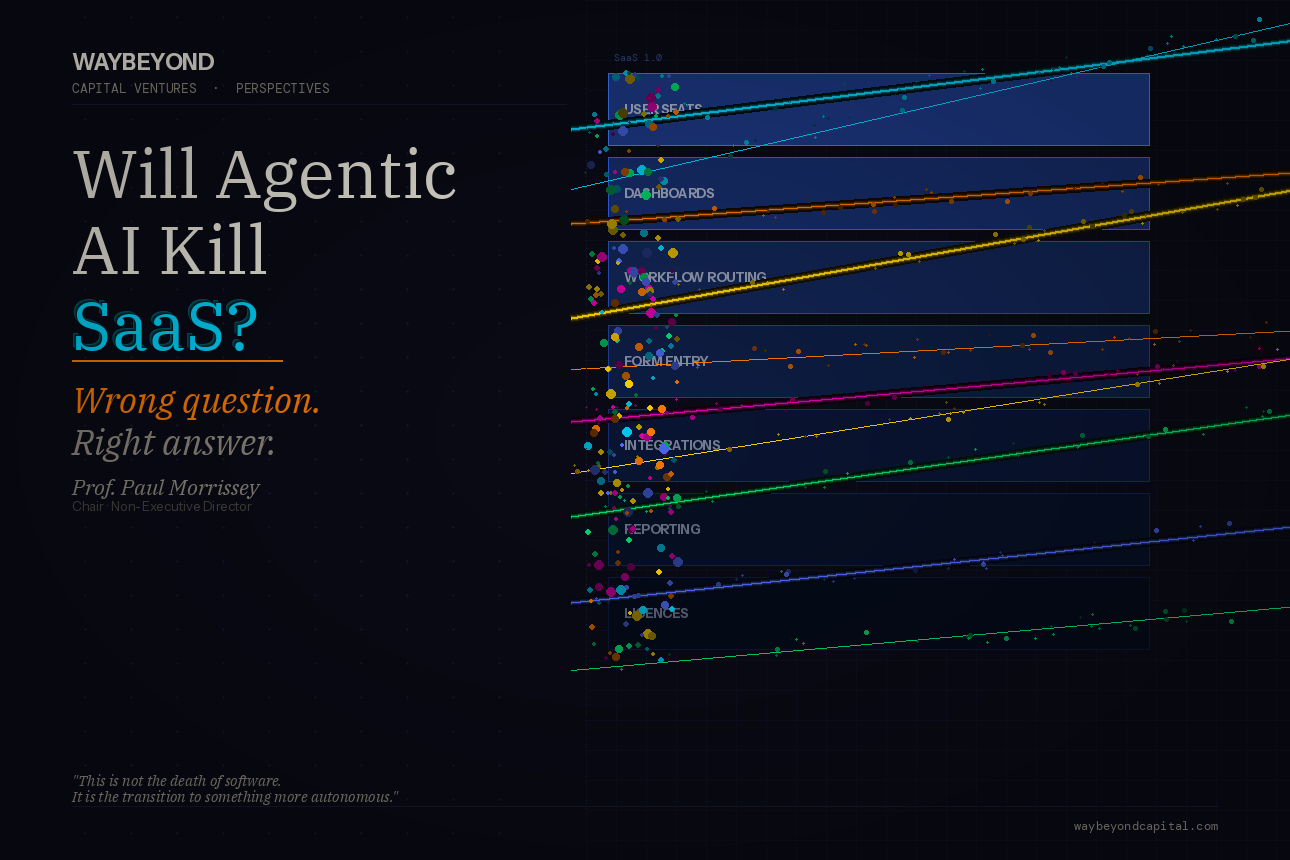
    Agentic AI vs SaaS: Is This the Beginning of the End — or the Next Evolution?

    Over the past few months, I have been asked the same provocative question again and again: “Will Agentic AI be the nail in the coffin for SaaS?” It’s a good question. But I think it’s the wrong one.

    The real question is this: Will Agentic AI expose which SaaS companies actually own real value — and which ones were simply renting convenience in the cloud? For the past two decades SaaS has been one of the most successful business models in technology.

    Subscription revenue, predictable cash flow, scalable delivery, and strong margins made it incredibly attractive to founders and investors alike. But a large portion of SaaS value has historically been built around user interfaces, workflow routing, dashboards, form entry and seat-based licences. In other words, SaaS often organised work rather than actually doing the work.

    Agentic AI changes that equation.

    Agentic AI systems can plan, execute and manage multi-step workflows autonomously. Instead of humans navigating multiple software tools, AI agents can increasingly complete the task themselves — resolving support tickets, updating CRM records, generating reports, reconciling invoices, or coordinating procurement processes. In short, the interface layer that defined much of SaaS may no longer be the Centre of gravity. That doesn’t mean SaaS disappears. But it does mean the economic model behind many SaaS companies is now under scrutiny.

    The companies that survive this shift will not be those that simply provide software. They will be those that control data, own critical workflows, operate in trusted domains, and can price based on outcomes rather than user seats. This is not the death of software. It is the transition from SaaS 1.0 to something much more autonomous.

    The Venture Capital Perspective

    From a venture capital perspective, software investment is not slowing down — but the type of software being funded is changing rapidly. AI companies accounted for the majority of venture capital investment in 2025, with roughly 61% of global VC funding going into AI-related companies [1]. Enterprise adoption is also accelerating quickly. One report found that 76% of enterprise AI deployments were purchased solutions rather than internally built systems [2]. In other words, investors are still enthusiastic about software businesses. They are simply shifting their capital toward AI-native platforms, vertical AI applications and agent-enabled workflow systems.

    What venture capitalists are becoming more cautious about is traditional SaaS that sits in the middle of a workflow but does not own the underlying data, decision logic, or automation layer. If an AI agent can orchestrate work across multiple tools, the value of those tools changes dramatically. The key question VCs now ask founders is simple: Why will your software still matter when AI agents can do the work themselves?

    Private Equity’s View

    Private equity investors are approaching the issue with characteristic pragmatism. Technology remains one of the most active sectors for private equity investment. Tech deals represented around 22% of North American private equity transactions in early 2025, and funds still hold hundreds of billions in undeployed capital targeting technology assets [3]. But the classic private equity SaaS playbook is under pressure. For years, PE firms could acquire a promising SaaS company, rely on rapid market expansion, increase revenue growth, and benefit from multiple expansion. Historically, the majority of value creation in technology buyouts came from revenue growth and valuation increases rather than operational improvements [3].

    Today that strategy looks more fragile. Higher interest rates, slower SaaS growth curves, and the disruptive potential of AI are forcing PE firms to become more selective. They are increasingly focused on companies that can use AI to improve margins, automate operations, and deepen product differentiation. In other words, private equity is not abandoning SaaS. It is simply demanding that SaaS businesses evolve into AI-enabled platforms with durable competitive advantages.

    The Family Office Perspective

    Family offices provide a particularly interesting perspective because their investment horizons are often longer and their capital structures more flexible. Most family offices already have some exposure to artificial intelligence. One report suggested that around 86% of family offices now have AI exposure, primarily through public market investments [4]. At the same time, around 65% intend to increase their focus on AI-related investments in the coming years [5].

    However, family offices are also becoming more cautious about valuations and private market liquidity. Despite this caution, both AI and SaaS continue to attract significant family office capital. In fact, venture deal values involving family offices more than doubled for both AI/ML and SaaS companies between 2023 and 2025, even though the total number of deals declined [6]. What this tells us is that family offices are concentrating capital into fewer, higher-quality opportunities rather than retreating from the sector entirely.

    They are asking the same question as other investors: Does this software business still matter in a world where intelligent agents are everywhere?

    My Conclusion

    So, will Agentic AI be the nail in the coffin for SaaS? For weak SaaS businesses, possibly yes. Companies with shallow product differentiation, limited data advantages and purely seat-based pricing models may find their value proposition eroded as automation expands. But for strong software companies, Agentic AI is not a coffin — it is a catalyst. It pushes the industry toward outcome-based software, deeper automation, and products that sit closer to real economic activity rather than simply organizing information. The companies that win in the next decade will not be those that simply manage workflows. They will be the ones whose systems actually perform the work, control the data, and deliver measurable outcomes.

    Serious investors are not turning away from software. They are simply becoming less tolerant of SaaS businesses that cannot explain why they will still matter in an AI-native world. And that may ultimately be the healthiest thing that could happen to the software industry.

    References

    [1] OECD – Venture Capital Investments in Artificial Intelligence Through 2025

    [2] Menlo Ventures – State of Generative AI in the Enterprise Report

    [3] Bain & Company – Global Technology Report 2025

    [4] Goldman Sachs – Family Office Investment Insights Report

    [5] J.P. Morgan – Global Family Office Report 2026

    [6] PwC – Global Family Office Deals Study 2025

  • The Importance of Board Disagreements

    The Importance of Board Disagreements

    Corporate boards exist at the heart of modern governance. They sit between ownership and management, responsible for ensuring that organisations are directed and controlled in ways that create long-term value while protecting the interests of stakeholders. The board’s responsibilities include oversight of strategy, monitoring performance and risk, and ensuring accountability to shareholders, regulators and society at large. Directors are therefore not merely advisers to management; they are stewards of the enterprise and must exercise independent judgement in the interests of the organisation’s future. 

    In practice, this responsibility requires boards to do far more than simply endorse the views of executives. The board’s purpose is to challenge, test and refine management thinking. Good governance depends on maintaining a clear distinction between those who run the company day-to-day and those who oversee its direction. Executives manage operations, while the board provides oversight, strategic guidance and accountability, ensuring that management decisions are aligned with the long-term interests of the company and its stakeholders. 

    One of the most misunderstood aspects of board effectiveness is the role of disagreement. Many people unfamiliar with governance assume that a well-functioning board should be harmonious and unified. In reality the opposite is often true. Healthy disagreement is not a sign of dysfunction but of engagement. When directors bring different perspectives, experiences and expertise into the room, debate becomes a powerful tool for better decision-making. Research on boardroom dynamics shows that “vigorous dissent” around strategic issues improves decision quality and helps boards avoid groupthink. 

    The danger of excessive consensus is that it can allow the status quo to persist unchallenged. Organisations, particularly successful ones, can easily fall into patterns of thinking that go unquestioned over time. Boards are uniquely positioned to disrupt this complacency. Non-executive directors and chairs are deliberately placed one step removed from daily management so that they can bring independence of thought and a broader perspective. Their role is to ask difficult questions: Why are we pursuing this strategy? What risks are we overlooking? What alternative options should be considered?

    Throughout my own career as a Chair and Non-Executive Director across multiple organisations, I have repeatedly seen how constructive disagreement strengthens decision-making. Boards are composed of individuals with different backgrounds, sectors of experience and personal insights. When those perspectives collide respectfully, they force deeper analysis and more robust conclusions. The best boardrooms I have been part of were not silent or overly polite; they were intellectually demanding environments where directors felt confident enough to question assumptions and challenge the executive team.

    This dynamic is essential because boards carry responsibilities that extend beyond shareholders alone. Directors must consider the impact of decisions on employees, customers, suppliers, communities and other stakeholders. Modern corporate governance frameworks emphasise the duty of directors to act in good faith and in the best interests of the company while balancing the expectations of multiple stakeholder groups. Such complexity inevitably generates differing viewpoints. A strategy that benefits shareholders in the short term may carry risks for employees or long-term sustainability. Debate in the boardroom allows those competing considerations to be surfaced and evaluated properly.

    The role of the Chair is particularly important in managing this process. Encouraging disagreement does not mean allowing conflict to become personal or destructive. Effective chairs create an environment where directors feel able to express opposing views while maintaining respect and trust among board members. Governance research distinguishes between “task conflict,” which focuses on differing ideas and strategies, and “relationship conflict,” which becomes personal and damaging. The challenge is to foster the former while preventing the latter. 

    In practice, this often means structuring discussions carefully and ensuring that every voice in the room is heard. Some directors are naturally more vocal than others, and the Chair must ensure that quieter members are invited into the debate. Diverse boards—whether in terms of professional background, gender, nationality or sector experience—tend to generate richer discussions precisely because they bring different mental models to the table. Diversity, therefore, is not only a social or ethical consideration but also a governance advantage.

    Yet disagreement is only the first step. Ultimately, a board must reach decisions. One of the defining features of effective governance is the ability of directors to debate vigorously and then unite behind a collective conclusion. Once a board decision is made, it becomes the responsibility of all directors to support that outcome publicly, even if individual members initially held different views. This principle of collective responsibility ensures that management receives clear direction and that the organisation benefits from decisive leadership.

    This pattern—robust debate followed by unified commitment—is one I have observed repeatedly across boards in different sectors. The discussions may be intense, the perspectives strongly held, and the analysis detailed. But when the process is conducted professionally and respectfully, the final outcome is almost always stronger than any single viewpoint brought into the room at the beginning.

    In an era of increasing complexity—technological disruption, regulatory change, sustainability pressures and geopolitical uncertainty—the importance of strong board governance has never been greater. Boards must guide organisations through uncertain terrain while safeguarding long-term value and stakeholder trust. To do this effectively, they must resist the temptation of easy consensus.

    The most effective boards are those where disagreement is not feared but welcomed. When directors challenge each other and the executive team with intellectual rigour, the board fulfils its true purpose: ensuring that decisions are examined from multiple perspectives and that the organisation moves forward with clarity and confidence. In that sense, disagreement in the boardroom is not a weakness. It is one of governance’s greatest strengths.

  • AI, Creativity, and the Next Rights Settlement: Why We Must Build the Future Without Hollowing Out the Artists

    AI, Creativity, and the Next Rights Settlement: Why We Must Build the Future Without Hollowing Out the Artists

    Alternate title:  From Tools to Teammates: AI’s Creative Upside — and the Rights Reckoning We Can’t Avoid

    I’ve spent much of my professional life watching industries change when a new “general‑purpose” technology arrives. Telecoms did it with digitisation and the smartphone. Media did it with streaming. Now the creative industries are doing it with generative AI — tools that can draft, compose, visualise, summarise, mimic and remix at a scale that would have sounded implausible a few years ago.

    When I speak with artists, producers, commissioners, publishers, and the engineers building these systems, I hear two truths at once. First: AI is expanding what creative people can do. Second: the current economics and governance of AI risk extracting value from the creative ecosystem faster than it can replenish itself. The optimistic story and the cautionary story are both real. The question is whether we can hold on to the upside while fixing the terms of trade.

    A vivid example captures the moment. When will.i.am and Mercedes‑Benz set out to re‑imagine the electric driving experience, they built a system where music can be separated into components — drums, melody, vocals, synth — and then recomposed in real time using live signals from the vehicle: acceleration, braking, steering and suspension travel. The result isn’t a playlist; it’s an adaptive soundtrack shaped by the way you drive. Projects like MBUX Sound Drive are a clue: AI’s most interesting creative applications are rarely about replacing people. They’re about new formats that weren’t previously possible.

    That kind of work depends on people comfortable living in two worlds at once: code and culture. One of the most compelling thinkers I’ve read at this intersection is Manon Dave, who leads the Future World Design team within BBC Research & Development — a remit focused on what “public service creativity” becomes in an age of AI, immersive media and creator economies.

    Spending time listening and reading people like Dave shifts how you think about AI. It’s not a single tool; it’s a new layer of capability. Used well, it compresses the distance between idea and execution. It lowers the cost of iteration. It expands the palette. It gives you a collaborator that never runs out of patience — a sounding board you can ask for ten variations, then a hundred more in a different style. For early adopters, that matters most at the exact points where creative work often stalls: writer’s block, a sonic idea you can’t quite capture, a concept that needs “one more angle” to land.

    This is where the public debate sometimes misses the point. Too much of it is framed as “will AI replace creators?” In most real creative workflows, replacement is not the right model. Collaboration is. Contemporary pop is commonly written by teams; major productions involve dozens of specialist roles. Creative work is already multi‑author. AI becomes another participant — but one whose contribution must be governed and accounted for if we want the ecosystem to remain fair.

    Historical analogies help us stay calm, but they don’t let us be complacent. When the synthesizer arrived, it provoked predictable anxiety. When Auto‑Tune became mainstream, it was treated as scandalous by some and indispensable by others. In time, both technologies became part of the standard toolkit, and the world didn’t end. What audiences ultimately rewarded was taste, originality and emotional truth.

    Generative AI differs from prior creative technologies in one crucial respect: how it learns. A synthesizer doesn’t need millions of recordings to be ingested. Auto‑Tune doesn’t require training on the back catalogue of human voices. Generative models, by contrast, are built by training on large datasets — and those datasets often contain copyrighted works. That’s why rights, consent and attribution aren’t side issues. They are the central issues.

    If AI becomes a system that can ingest the world’s creative output, learn from it, and then compete with it — while creators have no practical way to see what was taken, no practical way to license it, and no practical way to be paid — the long‑term result is a slow hollowing out. We get more content, cheaper content, faster content — and fewer sustainable careers to create the next generation of high‑quality work.

    We can already see the same tension in journalism, where publishers argue that large‑scale scraping and reuse by AI systems is undermining the economics of original reporting. When major UK news organisations coordinate publicly to push for standards around consent, attribution and licensing, that is a signal that the basic value exchange is breaking down.

    At the same time, we have to engage honestly with the arguments on the other side. AI developers — and some policymakers — claim broad access to data is necessary for innovation; that training is “transformative” rather than substitutive; and that heavy disclosure requirements could slow progress or expose commercial secrets. In the United States, at least one significant court ruling has leaned toward the view that training on copyrighted books can be fair use in certain circumstances, even while condemning the storage of pirated copies — a reminder that the legal landscape is contested and evolving.

    So what do we do? I think we need to treat “AI and creativity” as three problems with three kinds of remedies.

    The first is the fun one: keep building genuinely new formats — work that is additive rather than extractive. Sound Drive is interesting because it’s about interaction, not imitation. The same is true of experiments that make audio more immersive, make education more adaptive, or make accessibility features more powerful. In a BBC context, the most interesting question isn’t “can a model write a script?” It’s “what does public service storytelling look like when information can be contextual, conversational and responsive — and when audiences can participate rather than merely receive?” A modern re‑imagining of Ceefax for the age of conversational systems isn’t about replacing journalists. It’s about adding a layer of context that helps audiences make sense of what they’re already watching, without destroying the shared experience of watching together.

    The second is the “boring plumbing”: attribution, provenance and authenticity. If we can’t say where media came from, how it was edited, and what tools were used, trust collapses — and with it, the ability to pay creators for verified work. That’s why open provenance standards such as C2PA matter. They are not a silver bullet, but they are the kind of infrastructure that makes a healthier ecosystem possible in a world of cheap synthetic media.

    The third is the hard one: an enforceable rights settlement for training data and downstream use, built on four basics — meaningful consent, workable transparency, scalable remuneration, and accountability across the value chain.

    If those principles feel demanding, consider the alternative. Without them, we will drift into a market where a small number of platform companies capture most of the value, while creative labour is treated as an unpriced input. That outcome is not inevitable — but it will happen by default if we don’t actively design against it.

    I’m also wary of the lazy claim that AI will “level the playing field” automatically. It can, but only under certain conditions. AI gives superpowers to people who already have taste, craft and domain knowledge. A strong writer uses it to explore structure and argument faster. A skilled producer uses it to audition sonic ideas and refine arrangement choices. A great designer uses it to test composition and iterate. But when the foundation isn’t there, you often get a glossy imitation: technically passable, emotionally empty, instantly forgettable. In a market flooded with that kind of output, genuine skill becomes more valuable — but only if the economics of skill remain viable.

    I’m cautiously optimistic about the next decade. Entertainment will become more adaptive. Interfaces will become more personalised. Media will become more conversational. The best experiences will be those that treat AI as a co‑pilot, not an author — a system that helps humans do more human things, not less.

    But optimism is not a plan. A plan requires institutions — broadcasters, publishers, labels, collecting societies, regulators, standards bodies, and responsible AI developers — to align on foundations: workable licensing models, provenance standards embedded into tools and platforms, and transparency requirements that don’t collapse under lobbying. Above all, we need to make it easy for a creator — not just a major corporation — to set the terms under which their work can be used.

    The best future is one where creators can experiment with AI freely, where new forms flourish, and where rights are respected not as an afterthought but as a design constraint. If we get that right, AI will not be the end of creativity. It will be the beginning of a new creative era — one that rewards imagination and craftsmanship while ensuring the people who make culture can still make a living from it.

  • From Exit to Re‑Entry: A Manifesto for Agentic AI, Living Worlds, and the Next Era of Games

    From Exit to Re‑Entry: A Manifesto for Agentic AI, Living Worlds, and the Next Era of Games

    I have spent much of my professional life at the intersection of creativity, technology, and commercial reality. Games sit precisely at that crossroads. They are cultural artefacts, technical achievements, and economic engines all at once. When they succeed, it is because those three forces are aligned. When they fail, it is almost always because one has been allowed to dominate the others.

    This manifesto explains why exiting Lucid Games was the right decision at the right time, why I am now re‑entering the market through WayBeyond Capital Ventures, and why agentic AI represents not just another toolset, but a structural shift in how interactive (and many other) worlds will be imagined, built, governed, and sustained.

    This is written not as a prediction, but as a position.

    Technology has always been the canvas, not the backdrop

    Game developers have never waited for technology to mature politely. They push it, bend it, and often break it. From early arcade machines to modern real‑time engines, games have consistently acted as stress tests for computation, graphics, networking, and human‑computer interaction, indeed it is arguable that’s why GPU’s were invented!

    What matters is not raw capability, but what capability enables creatively. Each technological step forward reshapes production methods, team structures, budgets, and ultimately player expectations. That is why the current moment matters so much.

    Agentic AI is not an incremental improvement on existing tools. It represents a change in ‘kind’, not just degree.

    Unlike generative systems that respond to prompts, agentic systems can pursue goals, maintain memory, adapt strategies, and operate across multiple steps without constant human instruction. When applied to games, this changes the nature of interaction itself. It moves us from scripted illusion toward genuine behavioural complexity.

    Why the Lucid Games exit mattered

    Lucid Games was a Liverpool‑born studio that proved it could operate on the global stage. As the chairman I was there from the beginning.

    The team delivered under pressure, navigated the realities of AAA expectations, and demonstrated real creative and technical capability.

    In July 2023, Lucid Games was acquired by LightSpeed Studios, a Tencent subsidiary. This was a pivotal moment for the company and for those of us involved in its governance. The acquisition validated the value that had been built and placed the studio within a platform capable of offering scale, stability, and long‑term runway.

    For me, it was a strategically clean exit.

    Exits are often mischaracterised as abandonment or retreat. In reality, a good exit is an act of stewardship. It recognises when a company’s next phase is better served inside a larger ecosystem, and when value creation has reached a point where risk and reward are no longer proportionate for existing stakeholders.

    The Lucid transaction crystallised value, reduced execution risk, and created something far more important than capital: optionality.

    The acquisition positioned Lucid within a global AAA platform with deep resources and long‑term publishing ambition. For the board and shareholders, it represented a successful outcome in a market increasingly characterised by consolidation and rising development costs.

    Optionality creates perspective

    Optionality buys time. Time allows reflection. Reflection reveals patterns.

    Stepping away from day‑to‑day studio operations made one thing abundantly clear: the industry is approaching another structural inflection point. Rising costs, longer development cycles, player fatigue with formulaic content, and increasing scrutiny around monetisation have all created pressure.

    Agentic AI arrives into this environment not as a silver bullet, but as a catalyst. It will not fix bad design, weak leadership, or exploitative business models. But it will amplify whatever philosophy sits beneath it.

    That is why the question is not “will agentic AI be used in games?” The question is “who will use it well, and to what end?”

    From scripted worlds to living systems

    For decades, so‑called AI in games has been built on scripts, decision trees, and bounded randomness. These techniques have delivered remarkable experiences, but they are ultimately fragile illusions. Once players see the seams, immersion collapses.

    Agentic AI offers a path toward worlds that are not merely decorated with activity, but structured around agency.

    Non‑player characters can pursue goals independently of the player. Worlds can respond systemically rather than reactively. Narrative becomes less about authored sequences and more about shaped possibility spaces.

    This does not eliminate the role of the designer. On the contrary, it elevates it. Designers move from writing behaviours to designing *conditions*. From scripting events to shaping ecosystems.

    Why a venture studio, not another studio

    When I decided to re‑enter the market, I was deliberate about structure. I did not want to build “another games company” in the traditional sense. The opportunity is broader than any single title.

    That is why with a set of brilliant strategists I founded WayBeyond Capital Ventures as a venture studio.

    A venture studio is suited to moments of systemic change. It allows multiple ideas to be explored in parallel, shared infrastructure to be developed once, and talent to move fluidly across initiatives. It also allows governance, safety, and ethics to be embedded by design rather than bolted on later.

    WayBeyond Capital Ventures operates across technology, media, and telecommunications, because agentic systems do not respect sector boundaries. Games will be one of the most visible beneficiaries — but not the only one.

    The agentic lenses guiding re‑entry

    My re‑entry into gaming is guided by a set of lenses. These are not slogans. They are filters through which every opportunity is assessed.

    1. Living worlds, not larger maps 
    Scale is no longer measured in square kilometres. It is measured in density of believable behaviour. A small world that reacts intelligently will always outperform a vast but empty one.

    2. Agents as referees, not manipulators 
    Agentic systems can balance difficulty, detect unfair play, and manage pacing. Used correctly, they enhance trust. Used poorly, they become instruments of coercion.

    3. Production compression without creative hollowing 
    AI‑driven tools can remove enormous amounts of friction from development. But speed without taste produces mediocrity. Human judgement must remain central.

    4. Trust, safety, and governance by design 
    Agents can be subverted, manipulated, and pushed into unsafe behaviour. Robust guardrails, monitoring, and intervention systems are not optional — they are product fundamentals.

    5. Ethical monetisation as a hard constraint 
    An agent that emotionally nudges spending or withholds progress crosses a line. Long‑term value is built on respect, not exploitation.

    6. Augmenting, not erasing, human creativity 
    The future of games is not creator‑less. It is creator‑amplified. Removing drudgery should create space for imagination, not unemployment.

    The cultural responsibility of believable systems

    As worlds become more lifelike, the cultural responsibility of those who build them increases. Players form emotional relationships with characters, communities, and identities within games. Agentic systems deepen those bonds.

    That power must be handled carefully.

    Designers and leaders must ask not only “can we?” but “should we?” Not everything that is technically possible is culturally healthy or commercially sustainable.

    This is where governance becomes a competitive advantage rather than a compliance burden.

    Exit as preparation, not conclusion

    The Lucid exit was not the end of a chapter. It was the preparation for the next one.

    It created the distance needed to see clearly, the freedom to choose deliberately, and the responsibility to engage thoughtfully. Re‑entering the market now is not about chasing novelty. It is about shaping direction.

    Agentic AI will either deepen the medium or cheapen it. It will either empower creativity or industrialise it into sameness. The outcome depends entirely on the values of those who deploy it.

    The commitment

    WayBeyond Capital Ventures exists to back teams, platforms, and ideas that take this responsibility seriously. To build worlds that feel alive because they are coherent, responsive, and respectful — not because they are manipulative or overwhelming.

    This is not a call for unchecked acceleration. It is a call for disciplined imagination.

    The next era of games (and many other creative industries) will not be defined by how intelligent our systems become, but by how wisely we choose to use that intelligence.

    That is the work ahead. And that is why I am back.