Over the past few months, I have been asked the same provocative question again and again: “Will Agentic AI be the nail in the coffin for SaaS?” It’s a good question. But I think it’s the wrong one.
The real question is this: Will Agentic AI expose which SaaS companies actually own real value — and which ones were simply renting convenience in the cloud? For the past two decades SaaS has been one of the most successful business models in technology.
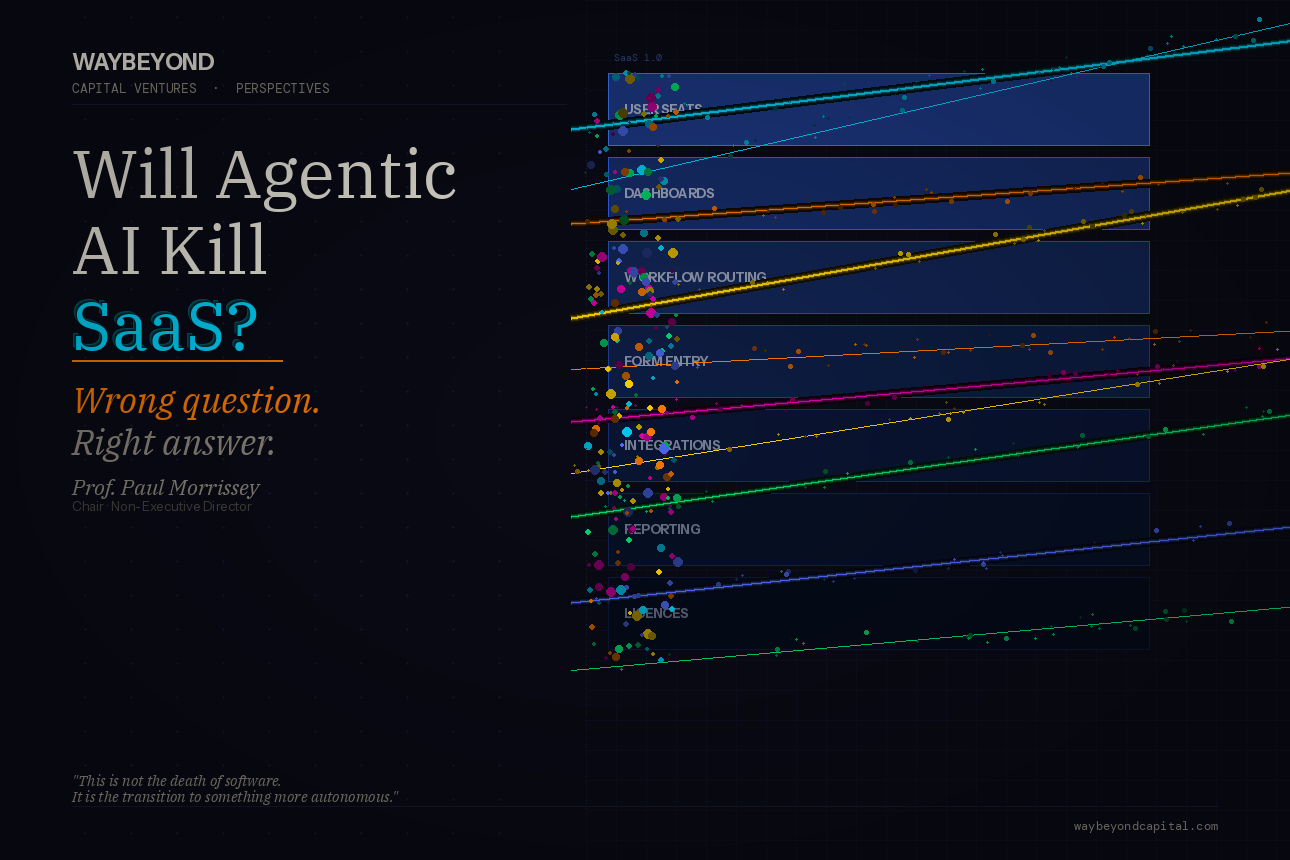
Subscription revenue, predictable cash flow, scalable delivery, and strong margins made it incredibly attractive to founders and investors alike. But a large portion of SaaS value has historically been built around user interfaces, workflow routing, dashboards, form entry and seat-based licences. In other words, SaaS often organised work rather than actually doing the work.
Agentic AI changes that equation.
Agentic AI systems can plan, execute and manage multi-step workflows autonomously. Instead of humans navigating multiple software tools, AI agents can increasingly complete the task themselves — resolving support tickets, updating CRM records, generating reports, reconciling invoices, or coordinating procurement processes. In short, the interface layer that defined much of SaaS may no longer be the Centre of gravity. That doesn’t mean SaaS disappears. But it does mean the economic model behind many SaaS companies is now under scrutiny.
The companies that survive this shift will not be those that simply provide software. They will be those that control data, own critical workflows, operate in trusted domains, and can price based on outcomes rather than user seats. This is not the death of software. It is the transition from SaaS 1.0 to something much more autonomous.
The Venture Capital Perspective
From a venture capital perspective, software investment is not slowing down — but the type of software being funded is changing rapidly. AI companies accounted for the majority of venture capital investment in 2025, with roughly 61% of global VC funding going into AI-related companies [1]. Enterprise adoption is also accelerating quickly. One report found that 76% of enterprise AI deployments were purchased solutions rather than internally built systems [2]. In other words, investors are still enthusiastic about software businesses. They are simply shifting their capital toward AI-native platforms, vertical AI applications and agent-enabled workflow systems.
What venture capitalists are becoming more cautious about is traditional SaaS that sits in the middle of a workflow but does not own the underlying data, decision logic, or automation layer. If an AI agent can orchestrate work across multiple tools, the value of those tools changes dramatically. The key question VCs now ask founders is simple: Why will your software still matter when AI agents can do the work themselves?
Private Equity’s View
Private equity investors are approaching the issue with characteristic pragmatism. Technology remains one of the most active sectors for private equity investment. Tech deals represented around 22% of North American private equity transactions in early 2025, and funds still hold hundreds of billions in undeployed capital targeting technology assets [3]. But the classic private equity SaaS playbook is under pressure. For years, PE firms could acquire a promising SaaS company, rely on rapid market expansion, increase revenue growth, and benefit from multiple expansion. Historically, the majority of value creation in technology buyouts came from revenue growth and valuation increases rather than operational improvements [3].
Today that strategy looks more fragile. Higher interest rates, slower SaaS growth curves, and the disruptive potential of AI are forcing PE firms to become more selective. They are increasingly focused on companies that can use AI to improve margins, automate operations, and deepen product differentiation. In other words, private equity is not abandoning SaaS. It is simply demanding that SaaS businesses evolve into AI-enabled platforms with durable competitive advantages.
The Family Office Perspective
Family offices provide a particularly interesting perspective because their investment horizons are often longer and their capital structures more flexible. Most family offices already have some exposure to artificial intelligence. One report suggested that around 86% of family offices now have AI exposure, primarily through public market investments [4]. At the same time, around 65% intend to increase their focus on AI-related investments in the coming years [5].
However, family offices are also becoming more cautious about valuations and private market liquidity. Despite this caution, both AI and SaaS continue to attract significant family office capital. In fact, venture deal values involving family offices more than doubled for both AI/ML and SaaS companies between 2023 and 2025, even though the total number of deals declined [6]. What this tells us is that family offices are concentrating capital into fewer, higher-quality opportunities rather than retreating from the sector entirely.
They are asking the same question as other investors: Does this software business still matter in a world where intelligent agents are everywhere?
My Conclusion
So, will Agentic AI be the nail in the coffin for SaaS? For weak SaaS businesses, possibly yes. Companies with shallow product differentiation, limited data advantages and purely seat-based pricing models may find their value proposition eroded as automation expands. But for strong software companies, Agentic AI is not a coffin — it is a catalyst. It pushes the industry toward outcome-based software, deeper automation, and products that sit closer to real economic activity rather than simply organizing information. The companies that win in the next decade will not be those that simply manage workflows. They will be the ones whose systems actually perform the work, control the data, and deliver measurable outcomes.
Serious investors are not turning away from software. They are simply becoming less tolerant of SaaS businesses that cannot explain why they will still matter in an AI-native world. And that may ultimately be the healthiest thing that could happen to the software industry.
References
[1] OECD – Venture Capital Investments in Artificial Intelligence Through 2025
[2] Menlo Ventures – State of Generative AI in the Enterprise Report
[3] Bain & Company – Global Technology Report 2025
[4] Goldman Sachs – Family Office Investment Insights Report
[5] J.P. Morgan – Global Family Office Report 2026
[6] PwC – Global Family Office Deals Study 2025